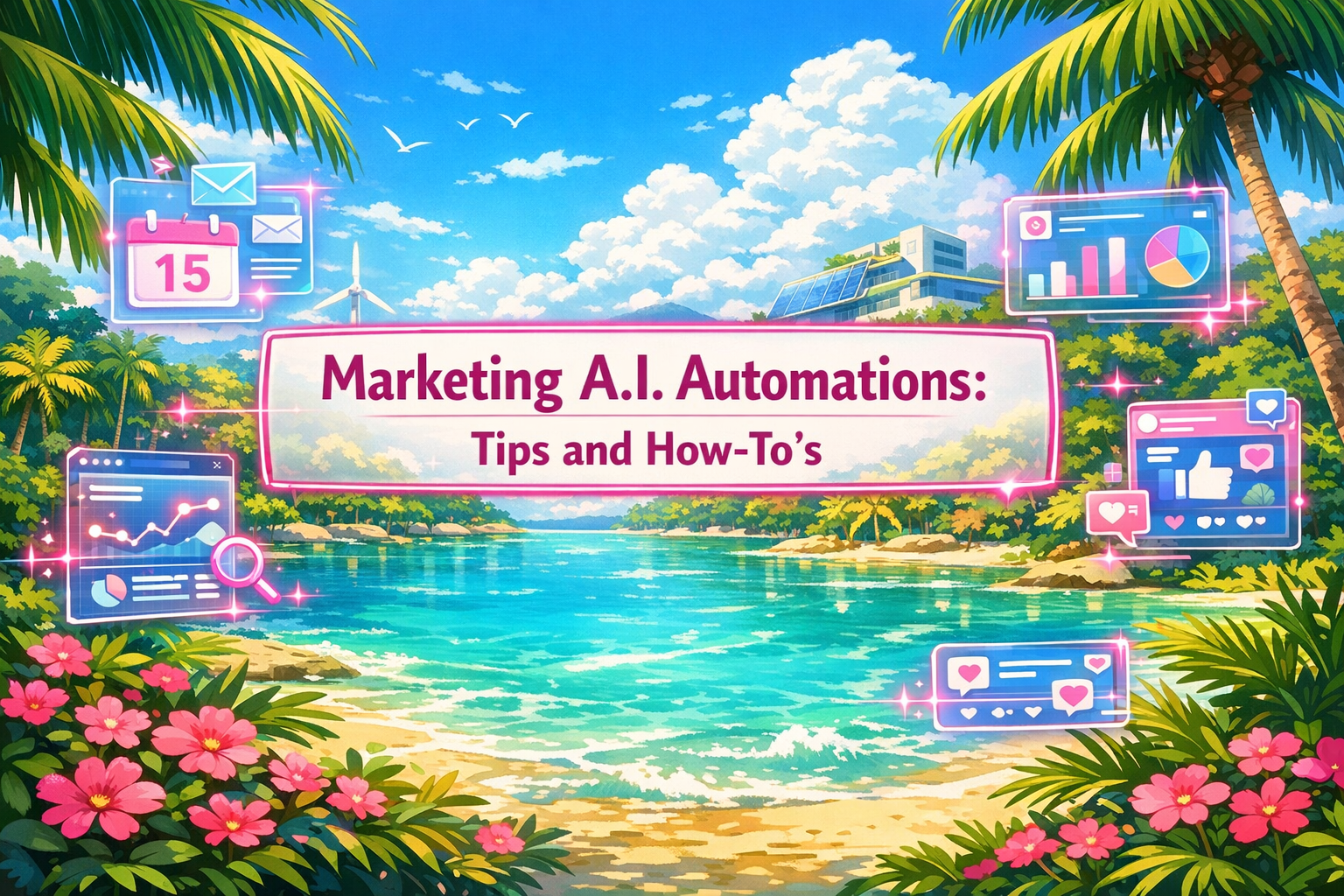
Marketing A.I. Automations: Tips and How-To’s for Small Business Owners
Marketing A.I. Automations can be a game-changer for small business owners who juggle many hats. This guide, Marketing A.I. Automations: Tips and How-To’s for Small Business Owners, breaks down practical steps to implement AI-powered marketing in a way that saves time, maintains quality, and scales with your business. From drafting newsletters to researching prospects, these automations are designed to handle repetitive work so you can focus on conversations that move your business forward.
What Marketing A.I. Automations Do
AI-powered marketing automations can handle a wide range of routine tasks with minimal human input. They can draft newsletters, schedule social posts, and keep a content calendar moving. In addition, AI agents can research prospects, draft personalized outreach, and track responses, providing a clearer path to meaningful conversations with potential customers. These capabilities aren’t theoretical; they’re being used by many marketers to streamline workflows and maintain consistency across channels.
For small businesses, the impact is often measured in time saved and the ability to punch above your weight with personalized communications. By letting AI handle the repetitive tasks, you free up mental space to craft strategic messages, close deals, and build stronger relationships with customers.
Why Marketing A.I. Automations Matter for Small Businesses
Small business owners frequently wear multiple hats. AI automations help by:
- Saving Time: Automating routine tasks reduces the hours spent on repetitive work.
- Maintaining Consistency: AI keeps your content calendar full and communications timely, even on busy days.
- Enabling Personalization at Scale: AI segments audiences and tailors outreach without requiring a manual, time-consuming process.
- Improving Lead Nurturing: Automated outreach and tracking ensure leads are engaged in a timely and relevant way.
Industry statistics underscore how mainstream AI is becoming in marketing. A recent industry report highlights that three-quarters of marketers are using AI to create content, and 71% say it fuels their creative process. This demonstrates that AI isn’t just a novelty; it’s a practical toolkit that supports both execution and creativity.
Getting Started: A Simple 6-Step Playbook
- Map out repetitive tasks: List the tasks you perform on a weekly basis (e.g., newsletter drafting, social posting, follow-up emails) and estimate the time each takes.
- Pick a low-risk workflow to start with: Choose a task that follows a predictable pattern and doesn’t involve sensitive data or money, such as appointment reminders or initial lead outreach.
- Set clear approval points: Decide which steps the AI can complete autonomously and where you want a human check before the final action (e.g., sending an email to a customer).
- Connect your tools: Integrate the calendar, email, CRM, and any payment or analytics tools so the AI can act across platforms.
- Measure time savings: Record the before-and-after time for the task and track how often the workflow runs to demonstrate value.
- Add the next workflow: Once the first task runs smoothly, duplicate the process for another area of your marketing, such as lead research or social scheduling.
Best Practices and Common Pitfalls
- Start small and iterate: Begin with a safe, low-risk task and refine the process before expanding.
- Preserve your brand voice: Always review AI-generated content to ensure it aligns with your voice and values.
- Maintain data privacy: Use compliant tools and avoid sharing sensitive customer information in ways you don’t intend.
- Monitor performance: Track engagement, open rates, and response times to verify the automation is improving results.
- Balance automation with human touch: Let AI handle routine tasks, but keep strategic, high-value conversations human-led.
Putting It into Practice: Real-World Impact
To maximize efficiency, consider combining AI capabilities across content creation, scheduling, and outreach. AI can draft newsletters and social posts, then you can tailor the voice to fit your audience. It can also research prospects, draft personalized outreach messages, and track responses, enabling you to focus on conversations that truly matter.
Start by mapping a week of routine tasks and selecting a single, low-risk workflow. Connect your tools so the automation can act on your behalf, and measure the time saved and the improvements in consistency and engagement. As the first workflow runs smoothly, replicate the approach for additional tasks to build a scalable, AI-assisted marketing engine.
Conclusion
Marketing A.I. Automations offer a practical pathway for small business owners to boost productivity, stay consistent, and personalize outreach at scale. By starting with a simple, low-risk workflow and iterating over time, you can unlock meaningful gains without sacrificing control or quality. As AI continues to mature, the most successful small businesses will be those who integrate automation thoughtfully and strategically into their marketing mix.
Need help with your web site, marketing, or AI Agents, call or text us at +1 (863) 225-1713